
What Is Ultra-Fine Bubble (UFB) Technology?
Definition and Physical Scale
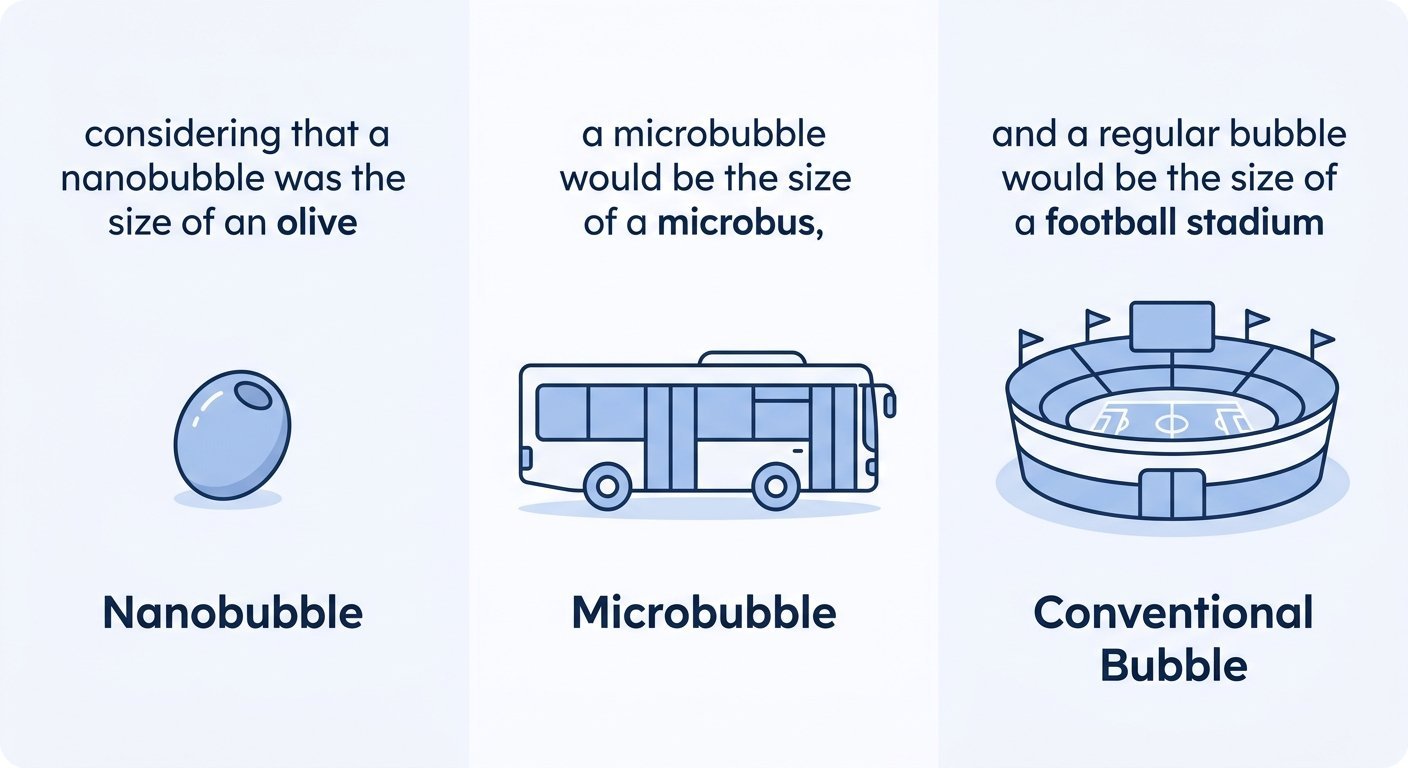
An ultra-fine bubble (UFB), commonly called a nanobubble, is a gas-filled cavity in water smaller than 200 nanometers — roughly 500 times narrower than a human hair. At that scale, buoyancy is no longer the dominant force acting on the bubble; Brownian motion is. The bubble does not rise. It remains suspended, in some cases for weeks, continuing to exchange gas with the surrounding water for as long as it persists.
This article sets out the physical mechanisms responsible for that behavior, the methods used to generate ultra-fine bubbles at scale, and the gases most commonly delivered through them — distinguishing, throughout, between what has been established in the literature and what remains under active study.
Nanobubbles vs. Microbubbles vs. Regular Bubbles
Stability Against Buoyancy and Coalescence
A bubble’s terminal rise velocity in still water follows, to first approximation, Stokes’ law: it scales with the square of the bubble’s radius. Halving a bubble’s diameter reduces its rise velocity by a factor of four; shrinking it to the nanoscale reduces buoyant force by many orders of magnitude — well below the threshold needed to overcome viscous drag and thermal agitation in the surrounding fluid. Below roughly 200 nanometers, a bubble’s trajectory is governed by random molecular collision rather than by buoyancy. It moves, but it does not rise.
A second property keeps these bubbles from merging back into larger, buoyant ones. Ultra-fine bubbles typically carry a negative surface charge, measured as zeta potential and commonly falling in the −20 to −40 millivolt range. This charge produces electrostatic repulsion between adjacent bubbles, inhibiting coalescence and allowing a population of nanobubbles to persist as discrete entities for hours to weeks, rather than combining into a smaller number of larger bubbles that would then rise and escape.
The combined effect — negligible buoyancy and resistance to coalescence — is what allows gas to remain dissolved and available in the water column over an extended period, rather than escaping at the surface within seconds, as a conventional bubble does.
Lower surface tension. Cleaner results with less chemistry.
Water’s surface tension arises from cohesive hydrogen bonding at its interface with air or a solid surface. When ultra-fine bubbles accumulate at a solid–liquid interface, they disrupt this cohesive network, measurably reducing surface tension at that boundary. The practical consequence is a lower contact angle: water wets a surface more completely, spreading further and penetrating more readily into porous or fibrous materials.
In cleaning and washing applications, this property reduces the surfactant threshold — the minimum detergent concentration required to achieve a given standard of soil removal. Laboratory studies on textile washing have reported equivalent or superior cleaning outcomes at meaningfully reduced chemical concentrations, though the magnitude of the effect varies with water hardness, temperature, and the specific soil or contaminant involved.
Surface Charge and Its Role in Separation
Besides preventing bubbles from merging, the surface charge of ultra-fine bubbles (UFBs) allows them to interact with other charged particles in water. This property is widely used in industrial separation processes.
The surface charge is quantified by the zeta potential, which measures the electrical potential at the boundary between the bubble surface and the surrounding liquid. Zeta potential is a standard parameter in colloid science and is used to describe the behaviour of suspended particles, droplets, proteins, and minerals—not only ultra-fine bubbles.
The zeta potential depends mainly on the water’s pH. In neutral and alkaline water, UFBs typically carry a negative surface charge. As the water becomes more acidic, the charge decreases, eventually becoming positive at sufficiently low pH.
Although this behaviour is well established experimentally, its exact origin is still debated. The most widely accepted explanation is that hydroxide ions (OH⁻) preferentially adsorb at the gas-water interface, creating a negative surface charge. However, other mechanisms have also been proposed, and the subject remains an active area of research in interfacial chemistry.
Regardless of its origin, the surface charge gives UFBs an important practical advantage: it can be controlled by adjusting the water’s pH, allowing the bubbles to interact selectively with different materials.
In mineral flotation, negatively charged UFBs attach preferentially to positively charged mineral surfaces, improving the recovery of fine particles while reducing the amount of flotation chemicals required.
In oily wastewater treatment, oil droplets are usually negatively charged. They naturally attach to bubbles because both are hydrophobic, but lowering the pH changes the bubble’s charge from negative to positive, creating an additional electrostatic attraction that improves oil removal.
The same principle is also used during coagulation and flocculation. Negatively charged UFBs interact with positively charged coagulants, promoting the formation of larger, denser flocs that settle more readily. This can improve solid-liquid separation while reducing the amount of coagulant required.
How Are Nanobubbles Made?
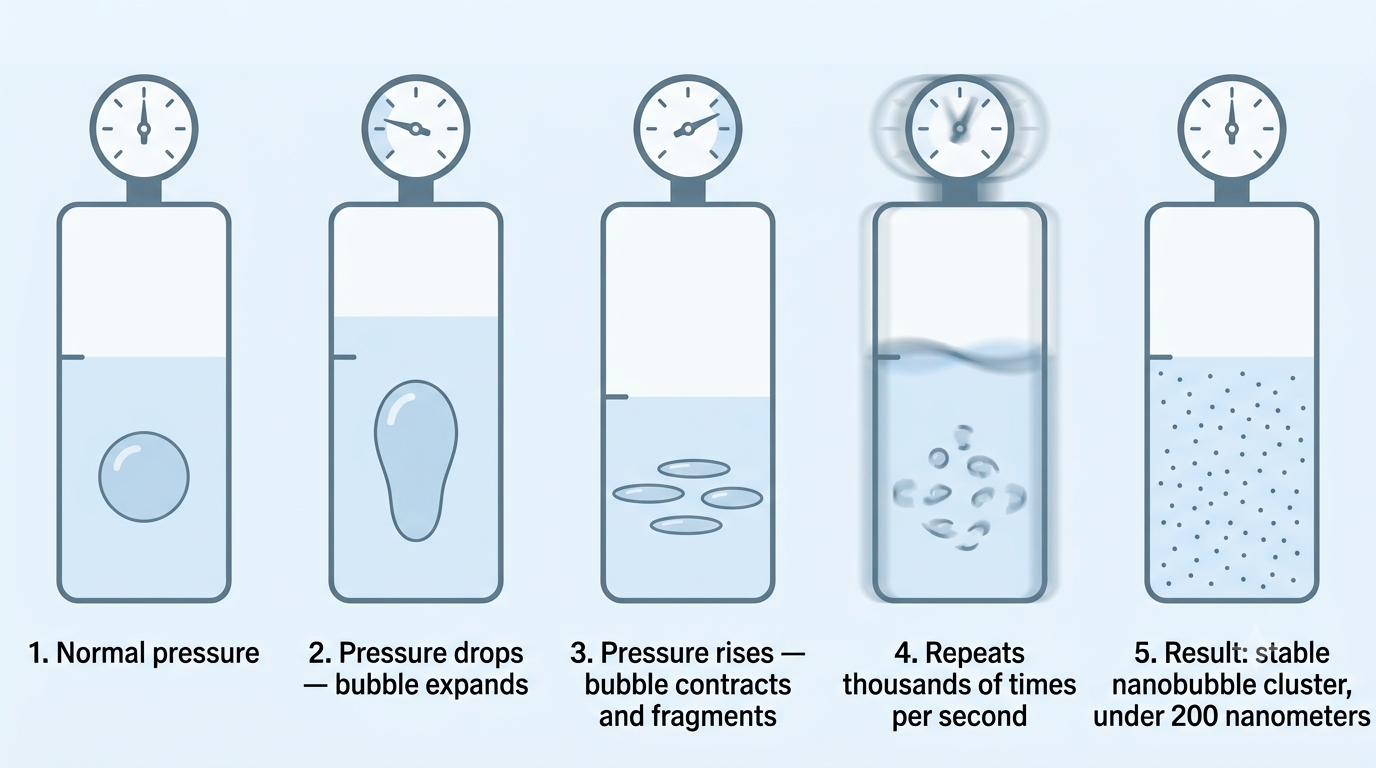
Generating a nanobubble starts with a much simpler idea: trap a pocket of gas inside water, then put it through a rapid, repeated pressure cycle. Picture a sealed cylinder of water with a pressure gauge on top. At normal pressure, a trapped bubble sits at its natural size.
Drop the pressure suddenly — the same way it drops for a fraction of a second as water rushes through a narrow restriction — and the bubble expands. Raise the pressure back just as fast, and the bubble is forced to compress again, hard. One cycle like this barely changes anything. But UFB generation equipment puts water through this exact expand-compress cycle thousands of times per second, using engineered flow paths rather than a single mechanical squeeze.
Each cycle puts the trapped gas under intense stress. Repeated enough times, a bubble that started at an ordinary size doesn’t just shrink — it shatters, again and again, into progressively smaller fragments. The illustration below shows the general idea with a handful of bubbles for clarity, but the real process goes much further: a single starting bubble can fragment into millions of bubbles, most of them smaller than 200 nanometers — roughly 500 times smaller than what’s pictured. At that size, they no longer have enough buoyancy to rise to the surface. They simply stay suspended.
The result is water that looks completely clear — no fizz, no cloudiness — but is actually carrying a huge concentration of gas, suspended and ready to interact with anything it touches.
How UFB Generators Work: The Main Methods
| Method | How it works | Benefit | Limitation | Common use |
|---|---|---|---|---|
| Pressurized dissolution | Gas is dissolved into water under high pressure | High nanobubble concentration; works with various gases | More energy-intensive equipment | Aquaculture, industrial water treatment |
| Gas-water circulation | Gas is introduced into a spinning vortex of water; fragmentation happens as the vortex breaks down | Mechanically simple, low maintenance | Lower concentration than pressurized dissolution | Continuous-flow systems |
| Hydrodynamic cavitation | Water is forced through a narrowing channel at high velocity, creating a rapid pressure drop that fragments gas already in the water | Scales well for high-volume continuous flow | Needs gas pre-dissolved or injected separately | Industrial and agricultural flow systems |
| Acoustic (ultrasonic) cavitation | High-frequency sound waves create rapid pressure oscillation directly in the water, with no physical constriction | Precise tunability of frequency and power; no moving parts in contact with the flow path | Concentration has a practical ceiling, and the effect weakens sharply within a few centimeters of the source | Lab-scale research, food processing, specialty water treatment |
| Electrolysis | Electric current splits water at the electrodes, generating gas (commonly hydrogen or oxygen) directly at the bubble’s point of origin | Produces a specific, known gas without external gas supply | Limited to gases produced by electrolysis | Specialty water treatment, research |
| Gas-permeable membranes | Gas is pushed through a membrane with extremely fine pores, diffusing directly into water on the other side | Gentle, controlled, no cavitation involved | Lower throughput; membrane fouling/maintenance | Precision dosing, sensitive applications |
Which gas to use depends on the application — see UFB Industrial Applications for a full breakdown by gas type and use case.
FREE DOWNLOAD
5 Nanobubble Myths Debunked
Get the PDF that separates verified effects from marketing exaggerations. Used by researchers, agronomists, and water treatment consultants.
Go deeper: Nanobubbles — What’s Real, What’s Hype
The e-book expands this article into a full myth-by-myth breakdown, a device-selection framework, and a quick-reference protocol guide — for engineers and buyers who need more than the summary version.